Thursday, 30 September 2010

Fashion & Textiles - "BULK"

Luckily in this rotation I found my concept quite early on.....

 B U L K 

I chose this word as I thought it connected with the project's overall name: Expand &/or Compress.
I suppose I've been influenced by the focus in 3D and Spatial which was modular elements - which when many are put together create a larger model. The negative space around the object becomes smaller as the object 'expands'.

So, I looked at reels of thread, hair, fluffy fabrics, wool, feathers, concertina shapes.
The amount of research I did really enabled me to come out with some interesting results. Sometimes the models just 'happened' through experimentation, but looking back to my research you can see that there are clear links. I was obviously subliminally influenced by them. 

Wednesday, 29 September 2010

Camera Obscura

Today in Seminar 1, we got talking about how through every age artists have uses technology or optical devices to improve their images. In David Hockney's investigative book "Secret Knowledge", we learn that  important artists began using optical devices as aids for creating their work early in the Renaissance, approximately 175 years before the time of Galileo.


All that talk about the camera obscura reminded me of some stunning images that I saw in a magazine a few years ago. I thought I'd have a go at re-finding them and I'm so glad I tried - see them below. They're undoubtedly gorgeous.

Taken by Abelardo Morell, these photographs are not tampered with via Photoshop!
No, not Mother Nature but Uncle Optics has aided the outcome of these images.
Morell travels the world and converts rooms into camera obscura devices.
By poking a tiny pin-hole in a a black out curtain the outside is naturally supimposed upon the room upside down. He captures the scene on a very slow shutter speed as the room is only 'lit' by what light enters through the pin-hole.


A short and helpful essay about optical devices:

http://www.mhest.com/spotlight/galileo/articles/UseOfOpticsByRenaissanceArtists.pdf

Tuesday, 28 September 2010

Eadweard Muybridge

After having seen the exhibition about Muybridge at The Tate Britain, I went home and researched him. I found it really interesting!


Eadweard Muybrigde, born Edward Muggeridge in Kingston Upon Thames, liked to call himself Helios (like the Greek Sun God) because of his affinity to light - the key to his photographic practice. His photographs are seen as important today as they demonstrated a great innovative quality. He was the one who first realised that with a sequence of photographs he could create the second to second movement of objects. The most iconic sequence is of a horse galloping.


Sunday, 26 September 2010

Ways Of Seeing - Chapter 1

What I got from this chapter:


It's about how we view the world around us.

How we see and how we interpret what we are seeing is different for everyone because each of us brings our own preconceived ideas, notions, assumptions, cultural differences.

Thus, we are never a neutral viewer; and there is no single perspective.

We can never view historic art in the same way due to this and the fact that our ideas now are modernised.

Reproduction devalues art for a few reasons being that you don't get to see the work in the same context as it is supposed to be seen ie. the church is was commissioned for; the aura is lost; its uniqueness is tainted.

In an effort to make the original piece meaningful and powerful again there is a mystique created around the piece. ie. Mona Lisa is so hyped up because it is so reproduced that people think that it important. But people who go to see the original are disappointed because they bring their own idea of how it looks in their head, thanks to the reproduced versions they have seen.

That there is a difference between seeing and looking. To be able to see and hear are natural abilities but to really look at something is an active reciprocal. So to see requires choice, decision making. It's an active thing. To take a photograph is a very concious thing. 


A useful breakdown of chapter 1 for those whose brain fails from time to time:-
http://www.designschoolstudent.com/

Friday, 17 September 2010

3D and Spatial Design


Having never experimented with 3D and spatial design, it was really insightful to see where my process took me. When I first started I struggled with paper manipulation, felt uninspired and pretty useless. It was only until I had got into the flow of it that I found that I was actually OK at it! I think that the amount of research I had put into it really helped as this always serves as a means of understanding how others have made models as well as inspirational aid.

The course has definitely had me thinking non-stop about the project. I've documented my thoughts, research and designs in an A5 sketchbook. You can really see how I came to my final outcomes if you look through it. I hope to carry this through into the next rotations. To improve the research process I will be making powerpoint presentations of images I find online with details of who's it is and where I found it. I didn't manage to keep track of the details very well in this project.

I've found that having a wealth of material aids and enables creativity. On the way to the station every morning, I scan the pavement for items that I could use for my models. Although I found processed items such as party poppers, cans, car parts and crisp packets, it was the organic shapes that I saw on my travels that influenced me the most. Nature definitely has a lot of modular shapes and patterns, so I took a leaf out of mother nature's book and used it in my work.

It was enjoyable to have a brief that pushed to you to create something of use. What I like about design is that it has a purpose - it makes me feel like the time spent towards making the object is worth while. Part of the brief was to make a support for the body. I made a prototype for a modern bobbly armchair which some people remarked that they would actually buy if they saw it in a store. That makes the pain of rolling those plasticine balls all worth while!

Wednesday, 15 September 2010

Lecture 1 "Frames of Reference"

Below I've posted the "names of", "comments on", and "links to" of the texts we were introduced to today in Lecture 1 "Frames of Reference".


Candice Breitz: "Queen (A Portrait of Madonna)"

Link to:
http://www.openspace.ru/mediathek/details/2038/http://www.boston.com/ae/celebrity/articles/2009/07/17/mfa_exhibit_takes_a_visual_look_at_music____with_help_from_madonna/?page=1

Quote from link:
“This piece is about our relationship to celebrities,’’ explains William Stover, the exhibit’s curator. “When you see these people onscreen, you understand the influence Madonna has had on them. [Breitz] keeps her own intervention to a minimum and lets the fans be who they are, and that’s liberating for us to watch.’’ Breitz is fascinated by the faceless swarms of people who consume pop culture fanatically and build their lives around it, Stover says. While the icons they emulate can be seen everywhere, the fans remain invisible."


Comments on:
My initial reaction was 'God, that sounds awful!'. These hardcore Madonna fans were invited to sing the lyrics to her entire album 'The Immaculate Collection". It's funny to see what an impact a celebrity has had upon these people. They try their best to emulate her voice, her actions, her lyrics. I wanted to turn off the video as soon as I could as their voices were painful to listen to - where as I wouldn't mind listening to the same lyrics sung by the artist who was meant to sing them. The song out of context to where it was intended to be gives me such a different perspective of it.

Richard Thompson: Oops I Did it Again

Link to:
http://www.guardian.co.uk/music/video/2010/may/30/richard-thompson-meltdown-festival

Notes on:

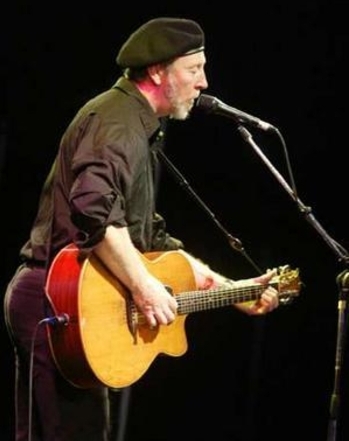
Thompson plays his own version of Britney Spears' 'Oops I Did It Again' to a humoured audience. He has incorporated an 16th Century style instrumental in to it.


Comments on:

This video had the lecture room laughing. This is such an iconic song for all of my age group. I had the image of a young, feminine and sexy Britney Spears performing the song in my head while I watched an old man with a guitar singing the same lyrics. It was interesting to see how the gender, age and appearance difference of the performances really changed the meaning of the lyrics. It seemed strange and silly to hear an unattractive, mature man sing:


"I think I did it again.I made you believe

We're more than just friends.

Oh, baby;

It might seem like a crush,

But it doesn't mean

That I'm serious.

'Cause to lose all my senses...

That is just so typically me.

Oh, baby; baby."


Refering to John Berger's 'Way of Seeing' it made me think about how a reproduced text can be read differently when taken out of the context it was made for.



Serpentine Gallery 2010 Summer Pavilion by Jean Nouvel

Link to:
http://www.serpentinegallery.org/2010/03/serpentine_gallery_pavilion_20_14.html


Notes on:

Modern red building in Hyde Park (London) where you can relax and play games.

It is a mediterranean experience for the public.

Mattise said red makes everything different.


Gregory Crewdson's Photo Alchemy

Link to:
http://www.npr.org/templates/story/story.php?storyId=5157819

Notes on:

Gregory Crewdon "makes not takes" photographs.

He has the aid of 75 people to construct the images/narratives.

He and his crew have spent up to a year on previous photographs.

These "dream images" often feature disturbing elements. See below an example of this as a woman (film star Jennifer Love Hewitt) floats on her back in a flooded living room.

Crewdson tries to achieve a sense of something having just happened.

In doing so he offers the viewer an unresolved narrative.


Wednesday, 8 September 2010

Freshers' Day

Freshers' Day was a laugh. Armed with my new found friend, Noor, a labelled map and £1 each to buy one another a gift, we set out to exlpore Chelsea.

Everyone in the lecture theatre sat speechless and friendless. A few minutes later, that all changed.


It was really interesting to see what the corridoors were lined with on our return. Everyone had to lay out the gifts we'd bought for £1 and label them with a post-it note as to why we chose the object. 


The first prize went to this guy who found his new feminine side.
This was a sweet gift - An embroidery with the theme of peace, bought for a girl who wants to join the army.
My present for Noor.
Noor's gift for me.

Another thing - we all brought in a sample of food that comes from our individual culture.
I won the prize for "Most Unappealing Offering". I don't see how I won that one ; )